• About Us
  • Rules for Editors
  • How It Works
  • Terms of Use
  • Privacy Policy
  • Contribute
  • Contact Us
  • Login
  • Register
Rawallian Community CareConnect
  • Home
  • Categories
  • Ask Question
  • About Us
  • Contact
No Result
View All Result
  • Home
  • Categories
  • Ask Question
  • About Us
  • Contact
No Result
View All Result
Rawallian Community CareConnect
No Result
View All Result
  • About Us
  • Rules for Editors
  • How It Works
  • Terms of Use
  • Privacy Policy
  • Contribute
  • Contact Us
Home Malnutrition

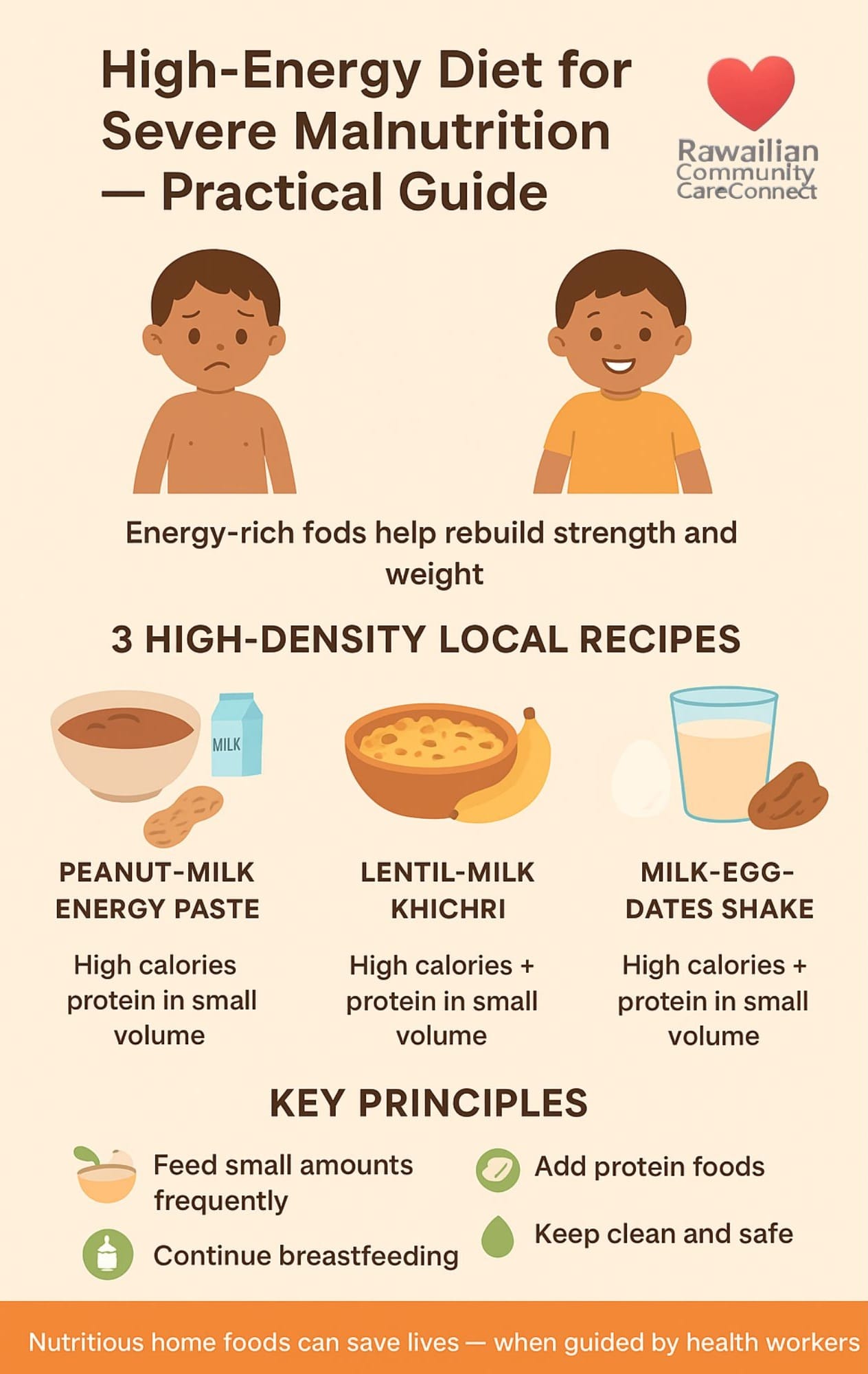
High-Energy Diet for Severe Malnutrition — Practical Guide

High-energy, high-protein foods and therapeutic feeding improve weight gain and recovery when used with medical care.

Mohammad Najeeb by Mohammad Najeeb
October 20, 2025
in Malnutrition
Reading Time: 8 mins read
1 0
A A
1
12
SHARES
20
VIEWS
Share on FacebookShare on Twitter

Severe malnutrition needs fast, careful action. In clinics and community programmes, treatment often uses specially made therapeutic milks (F-75, F-100) and ready-to-use therapeutic food (RUTF). These products are designed to safely give the high energy and micronutrients that a very weak child needs. Community and home foods can help when supervised, but RUTF/F-100 remain standard of care in most SAM programmes. WHO+1

Basic principles

  1. High energy & protein: food must give many calories and good protein in small volume.

  2. Frequent feeding: small feeds every 2–3 hours for weak children.

  3. Micronutrients: iron, zinc, vitamin A and others are essential — use supplements as advised by health worker.

  4. Treat illness: infections (diarrhoea, TB, HIV) must be treated together with nutrition.

  5. Medical supervision: SAM requires screening (MUAC, weight-for-height) and link to local CMAM or hospital services. NCBI+1

Safety note (read first)

  • If you see severe danger signs (child not feeding, very weak, severe diarrhoea, convulsions), go to hospital now.

  • Home high-energy recipes are not replacement for RUTF or hospital feeds in complicated SAM. Use them only under guidance of local health staff or when RUTF is not immediately available and health worker advises. UNICEF+1

Three easy high-density recipes (local, cheap, easy to make)

1) Peanut-Milk Energy Paste — (RUTF-style, family/clinic use)

Good where peanut allergy is not present. Soft paste, high in fat and energy.

Ingredients (makes ~10 small servings)

  • 500g roasted peanuts (skin removed) — ground to paste

  • 150g full-cream milk powder

  • 150g powdered sugar or jaggery (adjust to taste)

  • 120–150 ml vegetable oil or melted ghee

  • 1 tsp salt

  • Option: small sachet multivitamin/mineral powder (if available and advised by health worker)

Method

  1. Grind peanuts to smooth paste in blender.

  2. Mix milk powder and sugar into paste. Add oil slowly until smooth, thick paste forms. Add salt.

  3. If health worker provided micronutrient mix, add per instructions and mix.

  4. Give in small spoonfuls frequently (2–4 tsp every 30–60 minutes for weak child) or as advised.

Notes: store in clean container, room temp short term; use within 48–72 hours if kept cool. Seek health worker advice about portion and duration. This paste mimics energy density of RUTF but is not identical — use only when supervised. UNICEF+1

2) Lentil-Milk Khichri (High-Energy Porridge) — (for older infants & young children)

Soft, easy to digest, good protein + carbs.

Ingredients (serves 4 as supplement)

  • 1 cup yellow moong dal (split) or masoor dal, washed

  • ½ cup white rice or broken wheat (dalia)

  • 2 cups full-fat milk (or 1 cup milk + 1 cup water)

  • 2 tbsp ghee or oil

  • 1 medium banana, mashed or 2 tbsp dates paste (for energy)

  • Pinch of salt

Method

  1. Cook dal and rice together with 3–4 cups water until very soft and porridge-like.

  2. Mash to smooth consistency for small child. Add milk and ghee; simmer 2–3 minutes.

  3. Stir in mashed banana or dates for calories and taste. Cool to warm before feed.

Use: give in small frequent feeds. Good as complementary feed for child >6 months. Add a boiled egg (mashed) when the child can accept solids to raise protein. World Health Organization

3) Milk-Egg-Dates Shake (Energy + Protein) — (fast, no cooking)

Quick high-energy drink for older infants and children who can swallow liquids.

Ingredients (per serving)

  • 200 ml full-fat milk (warm)

  • 1 egg (fully cooked and cooled) or 1 tbsp powdered milk for safety if raw egg is avoided

  • 2 soft dates or 1 tbsp date syrup / jaggery dissolved

  • 1 tsp ghee (optional)

  • Mash or blend to smooth texture

Method

  1. If using whole egg, boil egg hard, mash well and blend into warm milk with dates and ghee. If using powdered milk, mix in directly.

  2. Serve warm in small frequent sips.

Notes: eggs add quality protein; dates and ghee add dense calories. Use for children >6 months and where no egg allergy. For infants under medical care, follow health worker advice. PMC

Practical tips for home feeding

  • Feed in calm setting, encourage but do not force.

  • Offer small frequent amounts; try different textures if one is refused.

  • Keep hygiene: boil/clean utensils and water to avoid infections.

  • Continue breastfeeding whenever possible — breast milk remains vital even while giving high-energy foods. WHO

When to seek health help: No weight gain after several days, poor appetite, signs of infection, vomiting, or severe weakness — contact nearest nutrition programme or hospital. CMAM programmes in Pakistan run community screening and provide RUTF and F-100/F-75 where needed. UNICEF+1


Discover more from Rawallian Community CareConnect

Subscribe to get the latest posts sent to your email.

Tags: malnutrition treatmenthome based nutrition therapyenergy dense foodsfeeding malnourished childrenfeeding guidelinesundernutrition managementrecovery from malnutritionnutrition educationnutrition for childrendiet for weight gainhealthy recipes for kidshigh calorie dietsevere malnutritioncommunity nutritionhigh energy dietpublic health nutritionnutrition rehabilitationprotein rich dietchild nutritionlocal food recipes Pakistan
Share12ShareTweet
Mohammad Najeeb

Mohammad Najeeb

As a result-driven public health physician with over 15 years of progressively responsible experience in maternal and child health, nutrition, and emergency programming, I have demonstrated exceptional proficiency in technical and operational support for program development and implementation. My expertise in program management, monitoring, and results delivery, coupled with my proficiency in cluster/sector management and partnership building, has allowed me to make significant contributions to the field of nutrition. I am well-versed in the areas of innovation, knowledge management, and capacity building, and have extensive experience in population-based nutrition and health assessments, as well as in the delivery community nutrition programmes at all levels. Furthermore, I possess strong interpersonal communication skills, swift management dexterity, and analytical thinking abilities, enabling me to make crucial decisions with ease. I am a highly motivated and compliant team performer, dedicated to achieving excellence in the field of public health

Related Posts

Early Childhood Development

Strengthen Your Body, Grow a Healthy Baby

October 24, 2025
86
Feeding Severely Malnourished Infants Aged Less Than 6 Months
Malnutrition

Feeding Severely Malnourished Infants Aged Less Than 6 Months

October 16, 2025
72
Feeling Tired All the Time? It Could Be Iron Deficiency Anemia (And Here’s How to Fix It)
Disease

Feeling Tired All the Time? It Could Be Iron Deficiency Anemia (And Here’s How to Fix It)

October 14, 2025
25
Malnutrition

Management of Malnutrition in the Context of HIV, TB, and Other Chronic Illnesses

October 10, 2025
20
Malnutrition

Malnutrition and Its Causes

October 9, 2025
17
Nutrition

Promoting Fish Intake

September 18, 2025
14
Next Post
Autistic Children Struggling with Sleep and Hyperactivity

Autistic Children Struggling with Sleep and Hyperactivity

exercise

Can a normal ECG rule out heart disease?

Please login to join discussion

Ask our Experts!

Have questions about common health concerns like colds, allergies, nutrition, or sleep? Don’t guess—get clear, reliable advice from qualified medical professionals. Fill in the form below to Ask the Experts today!

Recent Articles

  • گردے کی ناکامی میں مبتلا مریض کی خوراک۔
  • Why Taking Iron Pills and Malaria Medicine During Pregnancy Matters for Baby’s Birth Weight
  • Seasonal Changes in Breast Milk Nutrients: How Weather Affects Moms and Babies in Farming Areas
  • Are antibiotics necessary in recent onset sore throat?
  • Understanding and Addressing Aggression in Autism

About Rawallian Community CareConnect

Rawailian Community CareConnect is dedicated to empowering caregivers with simple, practical, and compassionate health information in everyday language. We provide a free, bias-free platform where professionals share short articles, videos, and podcasts—under 10 minutes—on caregiving topics across medical specialties. Our goal is to make knowledge accessible, support diverse communities through multilingual translations, and foster connection via forums and expert advice, all while growing collaboratively with minimal resources.

Quick Links

  • About Us
  • Rules for Editors
  • How It Works
  • Terms of Use
  • Privacy Policy
  • Contribute
  • Contact Us

Top Posts & Pages

  • گردے کی ناکامی میں مبتلا مریض کی خوراک۔
  • Why Taking Iron Pills and Malaria Medicine During Pregnancy Matters for Baby’s Birth Weight
  • Seasonal Changes in Breast Milk Nutrients: How Weather Affects Moms and Babies in Farming Areas
  • Are antibiotics necessary in recent onset sore throat?
  • Understanding and Addressing Aggression in Autism
  • شوگر اور پاکستانی غذا
  • Fathers’ Engagement in Early Learning
  • لاہور، سموگ اور فلو ۔ احتیاط اور علاج
  • SMOG & HEALTH
  • Why Autism Diagnosis Takes Time

Find by Categories

  • Autism Spectrum Disorder (11)
  • Cardio (4)
  • Disease (3)
  • Ear & Nose (1)
  • Early Childhood Development (7)
  • Emergency Care (1)
  • Gastroenterology (4)
  • Gynae (1)
  • Health (8)
  • Malnutrition (7)
  • Maternal & Infant (1)
  • Medicine (4)
  • Nutrition (10)
  • Ortho (2)
  • Paediatric (7)
  • Psychiatry (3)
  • Public Health (5)
  • Uncategorized (1)
  • About Us
  • Rules for Editors
  • How It Works
  • Terms of Use
  • Privacy Policy
  • Contribute
  • Contact Us

© 2025 Rawallian Community CareConnect

Welcome Back!

Sign In with Facebook
Sign In with Google
OR

Login to your account below

Forgotten Password? Sign Up

Create New Account!

Sign Up with Facebook
Sign Up with Google
OR

Fill the forms below to register

All fields are required. Log In

Retrieve your password

Please enter your username or email address to reset your password.

Log In

Add New Playlist

No Result
View All Result
  • Home
  • Rules and SOPs for Editors
  • Categories
  • About Us
  • My account
  • Contact
  • Login
  • Sign Up

© 2025 Rawallian Community CareConnect