
• About Us
  • Rules for Editors
  • How It Works
  • Terms of Use
  • Privacy Policy
  • Contribute
  • Contact Us
  • Login
  • Register
Rawallian Community CareConnect
  • Home
  • Categories
  • Ask Question
  • About Us
  • Contact
No Result
View All Result
  • Home
  • Categories
  • Ask Question
  • About Us
  • Contact
No Result
View All Result
Rawallian Community CareConnect
No Result
View All Result
  • About Us
  • Rules for Editors
  • How It Works
  • Terms of Use
  • Privacy Policy
  • Contribute
  • Contact Us
Home Malnutrition

Mental Health Support for Malnourished Chronically Ill Patients

Psychological care improves treatment adherence, appetite, and overall recovery in chronic disease with malnutrition

Mohammad Najeeb by Mohammad Najeeb
October 10, 2025
in Nutrition, Psychiatry
Reading Time: 5 mins read
0 0
A A
1
1
SHARES
16
VIEWS
Share on FacebookShare on Twitter

When any one is suffering from long illness like HIV, TB, cancer, or diabetes — and also malnutrition — the problem is not only in body but also in mind. Chronic (longterm) sickness makes people tired, worried, hopeless, and sometimes ashamed. When mind becomes weak, body also stop fighting.

For this reason, mental health support is as important as medicine or food in managing malnourished patients with chronic illness.

Understanding the Link Between Body and Mind

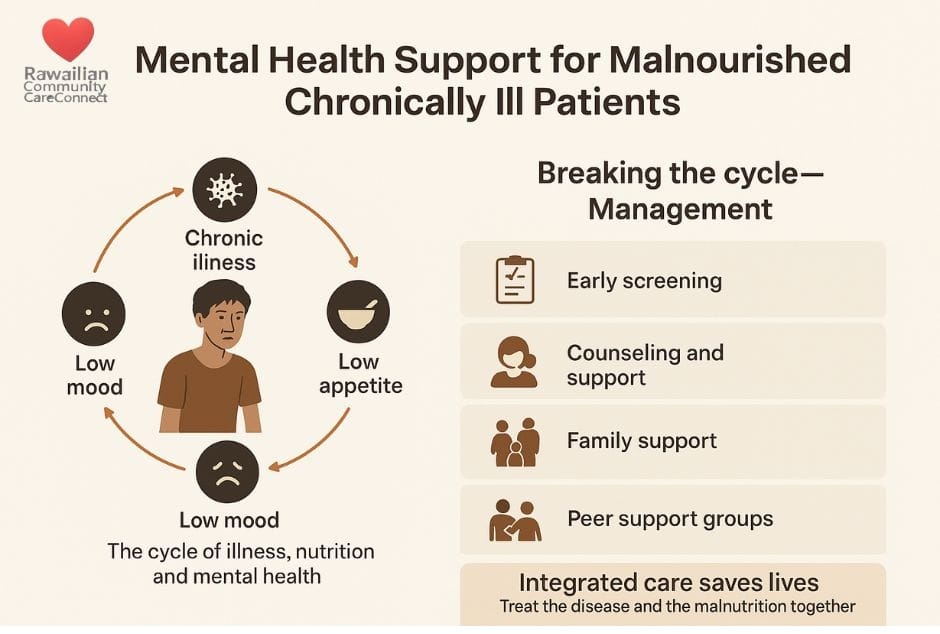
When a person is sick for long time, he lose weight, energy, and hope. Low nutrition affects brain chemicals that control mood, so malnourished patients often feel sad or anxious. On the other hand, depression reduces appetite — making nutrition even worse.

This creates a vicious cycle:

Illness → Poor appetite → Weak body → Low mood → Less eating → More weakness.

Breaking this cycle needs both nutrition and emotional support.

Common Mental Health Problems in Chronically Ill and Malnourished Patients

  1. Depression: Feeling of sadness, no interest in life, low appetite, poor sleep.

  2. Anxiety: Fear of disease, fear of death, worry about family or treatment cost.

  3. Hopelessness and Low Self-Esteem: Thinking “I am useless” or “I will never recover.”

  4. Stigma: Especially in HIV or TB, people hide their condition, which increase loneliness.

  5. Irritability or Aggression: From stress, pain, or hunger.

These emotional problems affect how patient follow diet and treatment. A depressed patient will not eat even if food is available.

Why Mental Health Support is Important

  • Improves appetite and nutrition intake.

  • Helps medicine adherence — patient take drugs on time.

  • Reduces stress hormones that damage body.

  • Gives motivation to recover.

  • Strengthens relationship with family and caregivers.

How to Provide Mental Health Support

1. Early Screening

Health workers should check not only body signs but also emotional condition. Simple questions like “Do you feel sad most days?” or “Do you have trouble sleeping?” can help identify depression early.

2. Counseling and Listening

  • Give patient time to talk about fear and worry.

  • Listen without judgment or blame.

  • Offer hope — explain that with food, medicine, and care, life can improve.

  • Use simple language and respect local beliefs.

3. Family Support

Family is main emotional system in Pakistani culture. When family show love, patient feel stronger. Encourage family to sit, eat, and talk with patient daily. Teach them not to blame the sick person or show pity, but to show respect and encouragement.

4. Peer Support Groups

For HIV, TB, or dialysis patients, meeting other people with same condition reduce isolation. Peer groups share experience, coping tips, and give hope.

5. Nutrition and Mental Health Link

Some nutrients like iron, zinc, omega-3, and vitamin B help mood regulation. Balanced meals improve not only body but also brain function. Encourage patient to eat small frequent meals with natural colors — vegetables, fruit, eggs, and pulses.

6. Faith and Cultural Strength

Religious belief is strong source of comfort for many patients in Pakistan. Prayers, positive faith, and community support can bring peace and hope. However, patients should not replace medicine or diet with only faith healing — both are needed together.

7. Professional Help

If patient show serious depression (no eating, no sleep, talking about death), refer to psychologist or psychiatrist. In hospitals or clinics, short counseling sessions can be arranged.

Challenges in Pakistan

  • Limited number of mental health professionals.

  • Stigma toward mental illness.

  • Lack of integration of psychology with nutrition and medical care.

  • Families often focus only on physical recovery.

To improve this, hospitals and nutrition programs should train health staff in basic counseling and mental health first aid.

Practical Tips for Health Workers and Caregivers

  • Speak kindly and slowly; never blame the patient.

  • Encourage small daily goals — “Let’s try to eat one more spoon today.”

  • Celebrate small improvements (gaining weight, eating full meal, better sleep).

  • Maintain calm and friendly tone during visits.

  • Avoid forcing food; instead, create comfort and trust.

Conclusion

A healthy body cannot exist without a healthy mind. In chronic illness and malnutrition, both need care together. Mental health support — through listening, counseling, family love, and positive community attitude — helps patients recover faster and live with dignity.

“Nutrition feeds the body, but hope feeds the will to live.”

All doctor, nurse, and family member should remember: treating depression, anxiety, and loneliness is part of nutrition therapy. Healing must include both food for body and care for the mind.


Discover more from Rawallian Community CareConnect

Subscribe to get the latest posts sent to your email.

Share1ShareTweet
Mohammad Najeeb

Mohammad Najeeb

As a result-driven public health physician with over 15 years of progressively responsible experience in maternal and child health, nutrition, and emergency programming, I have demonstrated exceptional proficiency in technical and operational support for program development and implementation. My expertise in program management, monitoring, and results delivery, coupled with my proficiency in cluster/sector management and partnership building, has allowed me to make significant contributions to the field of nutrition. I am well-versed in the areas of innovation, knowledge management, and capacity building, and have extensive experience in population-based nutrition and health assessments, as well as in the delivery community nutrition programmes at all levels. Furthermore, I possess strong interpersonal communication skills, swift management dexterity, and analytical thinking abilities, enabling me to make crucial decisions with ease. I am a highly motivated and compliant team performer, dedicated to achieving excellence in the field of public health

Related Posts

obesity
Nutrition

Why am i putting on weight?

November 19, 2025
20
ماں کی غذائیت کی طاقت ایک کامیاب حمل اور خوشگوار ماں بننے کے لیے
Health

ماں کی غذائیت کی طاقت ایک کامیاب حمل اور خوشگوار ماں بننے کے لیے

November 9, 2025
9
Early Childhood Development

Strengthen Your Body, Grow a Healthy Baby

October 24, 2025
86
Malnutrition

10 Tips on Psychological Care for a Severely Malnourished Child

October 14, 2025
10
Feeling Tired All the Time? It Could Be Iron Deficiency Anemia (And Here’s How to Fix It)
Disease

Feeling Tired All the Time? It Could Be Iron Deficiency Anemia (And Here’s How to Fix It)

October 14, 2025
25
Nutrition

Avoiding Excessive Tea Consumption

September 19, 2025
22
Next Post

Management of Malnutrition in the Context of HIV, TB, and Other Chronic Illnesses

Keep Little Hands Safe: The Hidden Dangers of Small Objects in Children’s Ears and Noses

Keep Little Hands Safe: The Hidden Dangers of Small Objects in Children’s Ears and Noses

Please login to join discussion

Ask our Experts!

Have questions about common health concerns like colds, allergies, nutrition, or sleep? Don’t guess—get clear, reliable advice from qualified medical professionals. Fill in the form below to Ask the Experts today!

Recent Articles

  • گردے کی ناکامی میں مبتلا مریض کی خوراک۔
  • Why Taking Iron Pills and Malaria Medicine During Pregnancy Matters for Baby’s Birth Weight
  • Seasonal Changes in Breast Milk Nutrients: How Weather Affects Moms and Babies in Farming Areas
  • Are antibiotics necessary in recent onset sore throat?
  • Understanding and Addressing Aggression in Autism

About Rawallian Community CareConnect

Rawailian Community CareConnect is dedicated to empowering caregivers with simple, practical, and compassionate health information in everyday language. We provide a free, bias-free platform where professionals share short articles, videos, and podcasts—under 10 minutes—on caregiving topics across medical specialties. Our goal is to make knowledge accessible, support diverse communities through multilingual translations, and foster connection via forums and expert advice, all while growing collaboratively with minimal resources.

Quick Links

  • About Us
  • Rules for Editors
  • How It Works
  • Terms of Use
  • Privacy Policy
  • Contribute
  • Contact Us

Top Posts & Pages

  • گردے کی ناکامی میں مبتلا مریض کی خوراک۔
  • Why Taking Iron Pills and Malaria Medicine During Pregnancy Matters for Baby’s Birth Weight
  • Seasonal Changes in Breast Milk Nutrients: How Weather Affects Moms and Babies in Farming Areas
  • Are antibiotics necessary in recent onset sore throat?
  • Understanding and Addressing Aggression in Autism
  • شوگر اور پاکستانی غذا
  • Fathers’ Engagement in Early Learning
  • لاہور، سموگ اور فلو ۔ احتیاط اور علاج
  • SMOG & HEALTH
  • Why Autism Diagnosis Takes Time

Find by Categories

  • Autism Spectrum Disorder (11)
  • Cardio (4)
  • Disease (3)
  • Ear & Nose (1)
  • Early Childhood Development (7)
  • Emergency Care (1)
  • Gastroenterology (4)
  • Gynae (1)
  • Health (8)
  • Malnutrition (7)
  • Maternal & Infant (1)
  • Medicine (4)
  • Nutrition (10)
  • Ortho (2)
  • Paediatric (7)
  • Psychiatry (3)
  • Public Health (5)
  • Uncategorized (1)
  • About Us
  • Rules for Editors
  • How It Works
  • Terms of Use
  • Privacy Policy
  • Contribute
  • Contact Us

© 2025 Rawallian Community CareConnect

Welcome Back!

Sign In with Facebook
Sign In with Google
OR

Login to your account below

Forgotten Password? Sign Up

Create New Account!

Sign Up with Facebook
Sign Up with Google
OR

Fill the forms below to register

All fields are required. Log In

Retrieve your password

Please enter your username or email address to reset your password.

Log In

Add New Playlist

No Result
View All Result
  • Home
  • Rules and SOPs for Editors
  • Categories
  • About Us
  • My account
  • Contact
  • Login
  • Sign Up

© 2025 Rawallian Community CareConnect