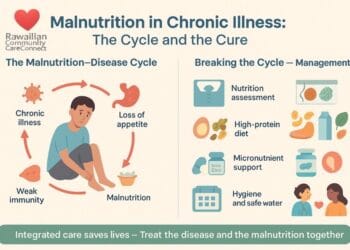

Early breastfeeding and supportive feeding restore nutrition and immunity in malnourished young infants.
Early breastfeeding and supportive feeding restore nutrition and immunity in malnourished young infants.
Malnutrition in babies less than six months old is a serious and sensitive problem. These small infants are very weak, and even a small mistake in feeding can risk their life. The first six months are the base for life — if a baby gets proper milk and care during this time, his body and brain develop strong.
What is Severe Malnutrition in Infants
A baby under six months is called severely malnourished when he looks very thin, weak, stops gaining weight, or shows visible ribs and loose skin. Sometimes the baby also becomes sleepy, cries weakly, or refuses to feed.
Health workers use a test called MUAC (Mid-Upper Arm Circumference) or weight-for-length to check. But for very young babies, most important signs are poor feeding, weight loss, and illness.
Why Malnutrition Happens in Small Babies
There are many reasons that cause poor nutrition in babies under six months:
- Poor Breastfeeding Practice – The baby not attached properly to the breast, milk not flowing, or mother gives other milk too early.
- Mother’s Poor Nutrition – When mother herself is weak, she cannot produce enough breast milk.
- Illness in Baby – Repeated diarrhea, chest infection, or low birth weight babies lose energy fast.
- Use of Bottle or Formula – Unclean bottles or over-diluted formula cause infection and poor growth.
- Mother’s Mental Stress – Depression, anxiety, or lack of support can reduce milk production and bonding.
- Cultural Practices – Some families give honey, ghutti, or water before six months — this is harmful.
Why Breast Milk is the Best Medicine
Breast milk is the most complete food for a baby. It has water, fat, protein, vitamins, and antibodies — all in perfect balance.
- It protects from diarrhea, pneumonia, and other infections.
- It helps baby grow and build strong brain.
- It comforts and connects mother and baby emotionally.
For a severely malnourished baby, breast milk is both food and medicine.
Management and Feeding Steps
1. Keep the Baby with Mother
The baby should always stay close to mother — skin-to-skin. This helps warmth, bonding, and milk flow. It’s called Kangaroo Mother Care (KMC).
2. Re-establish Breastfeeding
- Encourage the mother to feed every 2–3 hours, even at night.
- Help baby to attach properly — baby’s mouth wide open, chin touching breast, areola mostly inside.
- If baby too weak to suck, express mother’s milk and give with a small cup or spoon (never bottle).
3. Support the Mother
- Give her extra food — she needs energy to make milk.
- Encourage rest, emotional care, and family help.
- Teach her that stress can stop milk, but calm and patience bring milk back.
4. If Mother’s Milk Not Available
If the mother is very sick or has died, the best option is wet nursing (another healthy mother feeds the baby).
If not possible, use donor human milk (in hospital milk bank).
Formula should be the last option, used only under doctor’s supervision — and it must be made safely with boiled water and clean utensils.
5. Treat Illness
Many malnourished babies have infections. Health staff must check and treat with antibiotics if needed.
Dehydration, low blood sugar, or low temperature must be treated urgently.
6. Monitor Weight and Feeding
Weigh the baby daily or weekly to see if weight is improving.
Baby who starts feeding well, becomes active, and gains weight steadily is recovering.
When to Take the Baby to Hospital
- If baby stops feeding
- Has fever, vomiting, or diarrhea
- Breathing fast or chest sinking
- Looks very thin or weak
- Sleeps too much or not moving
Early hospital visit can save life.
Role of Health Workers and Family
Health workers should train mothers on proper latching, exclusive breastfeeding, and early danger sign recognition.
Family members must support the mother — give her food, let her rest, and keep the home calm and clean.
Prevention
- Exclusive breastfeeding for first six months (no water, ghutti, or other milk).
- Start feeding within one hour of birth.
- Continue breastfeeding day and night.
- Keep baby warm and clean.
- Support the mother’s nutrition and mental health.
Conclusion
Feeding a severely malnourished baby under six months is delicate but possible with care, love, and right guidance. The mother’s milk, gentle touch, and emotional support are the main treatment.
“When you feed the mother, you heal the child.”
Strong families, trained health workers, and community awareness can save many small lives.
Discover more from Rawallian Community CareConnect
Subscribe to get the latest posts sent to your email.